


In the Girona regions meat and pork products are highly valued, a fact that is already documented in the classics, such as Strabo or Martial, who praised the nobility of the hams from Cerdanya. The Greek sage Strabo (c. 63 BC – 24 AD), in Chapter 4 of Book III of his magna Geography, wrote: “The Iberian slope of the Pyrenees has beautiful forests of trees of all species and in particular evergreens. The Celtic side is bare, but the central area has perfectly habitable valleys. Most of the area is inhabited by the Ceretani, of Iberian descent, among whom excellent hams are produced that rival those of Cibira and bring great prosperity to their people. The poet Marcial also claims the ham from these regions in book XIII of the Epigrams: “May they serve me ham from the country of the Ceretani (…)”.
Good pigs, good hams, and great imagination to fill the pantry with pickled, cured, and dried delicacies from these cherished animals, which, until the end of the 19th century, had dark coats. Today the situation is similar: each town has its own artisanal butchers, who compete to offer the best cold cuts; each town boasts of making the best pork products. Some companies have helped improve the overall quality of pork products, making cold cuts — whether dried or cooked, thin or thick — even better. As a result of this constant evolution, the bread with oil eaten in Iberian times, became bread with tomato thanks to the introduction of many products from America. And bread with tomato (in Catalan, pa amb tomàquet) and cold cuts became one of the iconic ingredients in Catalan gastronomy.
Cold cuts with the 2025-2026 Girona Excel·lent seal
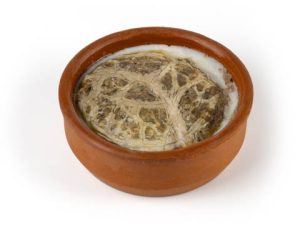
Pa de fetge (liver sausage)
Artisan butcher Xavier Alemany Juanola, from Banyoles, where he has his workshop, founded the Carnisseria Alemany butchers in 1998 at the Lleó Market in Girona. Their main aim is to maintain traditional production methods, to ensure food safety and quality, and to transmit and disseminate the traditional artisanal products of Catalonia. As a result they have been recognised several times by the Girona Excel·lent seal and won national competitions. At Carnisseria Alemany they make this liver meatloaf with jowls, sirloin, liver, eggs, cream, cognac, salt, pepper, garlic, parsley, nutmeg, cinnamon and cloves. Chopped, kneaded, wrapped in pork caul fat and cooked in a mould.
Company: Carnisseria Alemany
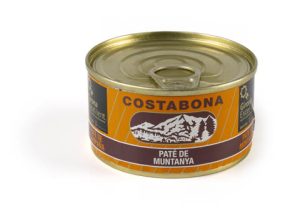
Country-style paté
The third generation at Embotits i Patés Costabona in Molló is now preparing this classic country-style paté according to their grandfather’s recipe, who was of French origin. It is made with pork jowls and liver, whole cow’s milk, eggs, wheat flour, salt, pepper and curing salts. This country-style paté was also the first product that this business made in the Pyrenees when they opened their shop in the 1960s. The grandparents had a shop in the town square where, in addition to basic groceries, they sold products that they produced themselves.
Company: Embotits i Patés Costabona
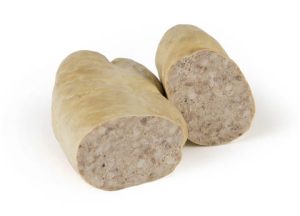
Masia Empordà White Sausage
White sausage is one of the most typical cooked sausages and comes in countless forms: with liver, with tongue, with pork meat, with egg, with garlic and parsley. At Masia Empordà they have the purest product: lean, pork belly and jowls (92%), salt and pepper, stuffed in natural casing. The most valued white sausage is usually the sausage made in large pig intestines, the peltruc. It is very tasty and ideal to eat with bread and tomato, but especially in the middle of a tomato and oil-soaked roll.
Company: Masia Empordà
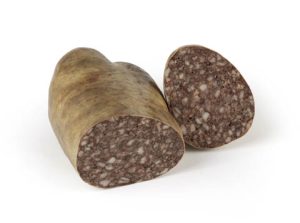
Masia Empordà Black Sausage
Black sausage is the most appreciated and iconic sausage of all the pork derivatives. Thin or thick, fresh or tender, it is an ingredient in some of the great dishes of Catalan cuisine, starting with escudella and ending with broad beans and peas. It is added to stews and rice dishes, cooked in omelettes and can be eaten as a snack with bread and tomato, or used to accompany sea urchins. At Masia Empordà they make it with pork (90%), pork blood (7%), salt and pepper, and stuff it in natural casing, both in the large intestine – the peltruc – and in the small intestine.
Company: Masia Empordà
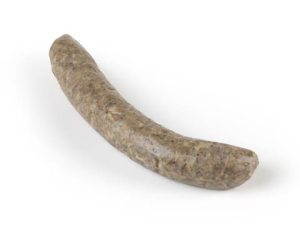
Perol Sausage
Xevi Capdevila and Montse Planchart make this mellow perol sausage with head meat, jowls, cheeks, heart, kidneys, salt and pepper, cook it in a perol boiler. Montse Planchart Coll is the daughter of Pilar Coll, who began working at Can Pau, in Osor, in 1955. In 1972 the Planchart Coll family took over the grocery and butcher shop which opened in 1940. Now it’s Comestibles i Carnisseria Pilar Coll, and they make the best perol sausage you can get today. Parracs sausage is one of the tastiest and most versatile sausages in Catalan cuisine, both in home cooking and in restaurants, to eat on its own or in a vegetable or legume dish.
Company: Comestibles i Carnisseria Pilar Coll
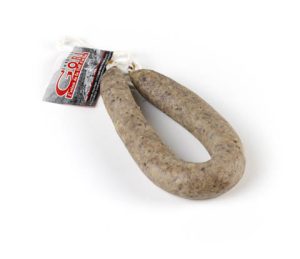
Perol Sausage with Santa Pau beans
Embotits Artesans Gori, charcuterie in Sant Privat d’en Bas, La Garrotxa, since 1925, renowned for their perol sausage made with head meat, jowl, heart, salt and pepper, have created this new version, adding Santa Pau beans (10%), while stuffing and cooking it in edible natural casing. In fact, they have paid homage to the gelatinous perol sausage cooked and served with Santa Pau beans.
Company: Artesans Gori
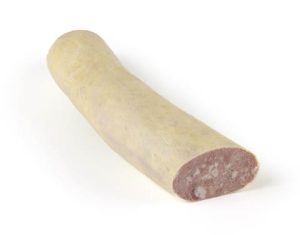
Catalan botifarra
Enric Torrent Navarra belongs to the third generation of the owners of the Pelai butcher shop, in Sant Climent Sescebes, founded in 1933. Its delicious Catalan botifarra is based on the combination of aromas provided by nutmeg, vermouth and an herbal liqueur with egg. It uses shoulder and lean pork, which it packages in tripe. This sausage is ideal for adding to starters, sliced extremely thinly, or for making a sandwich with tomato, if sliced a little thicker.
Company: Carnisseria Xarcuteria Pelai
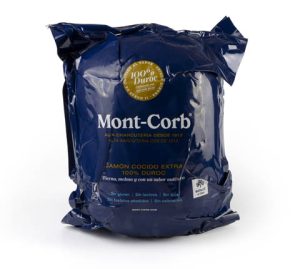
Extra cooked ham 100% Duroc
A century ago, in the roaring 1920s, cooked ham arrived, a product with an attractive pink colour achieved by adding curing salts which are also essential in the preparation of Catalan botifarra. Mont-Corb cooked sweet ham is made with a whole Duroc pork hock, water, salt, sugar, curing salts, spices and aromas. It is a delight eaten with your fingers, immediately after cutting it, either in thin slices or as shavings.
Company: Mont-Corb
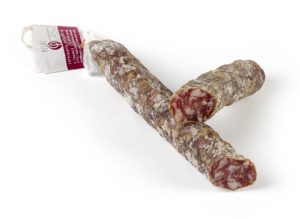
Fuet
Fuet also called espetec (snap), is one of the most typical dried sausages in Catalan gastronomy. It is long and thin, whitish on the outside and pink on the inside, and is usually eaten soft, although it used to be left to age for a long time until it acquired a rigid consistency; this is why, when it was broken with the hands, it made a very characteristic dry ‘snap’ sound, hence the name by which this product is known today. Enric Torrent uses lean shoulder meat, salt, pepper and curing salts, which he chops and packs in natural pork casings, and matures for three weeks or a month.
Company: Carnisseria Xarcuteria Pelai
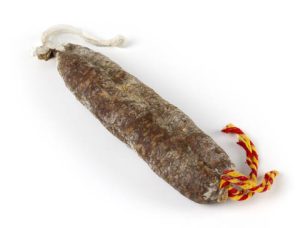
Llonganissa
Llonganissa is made with fine meats and a little fat, all minced and mixed with salt, sugar, pepper and curing salts. The fourth generation of Can Fanera, a company founded in 1928 in Plaça de la Vila, in La Cellera de Ter, makes llonganissa with pork shoulder (60%) and belly bacon (40%), which it minces, seasons and stuffs into large pork casings and leaves to mature until this noble sausage reaches the optimum point of curing.
Company: Can Fanera
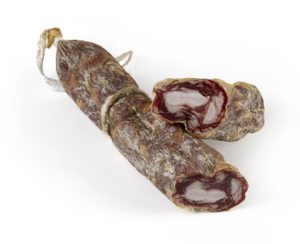
Piumoc or Sack of bones
The piumoc or sack of bones was one of the preserves for satisfying the appetite in La Garrotxa. Made with pieces of pork rib, bone marrow and a little fat with lean meat attached, seasoned with salt and black pepper, and stuffed into natural casing, it is left to dry and mature for a few months. It is one of the great ingredients in stews, especially with beans and peas, and alongside black sausage.
Company: Vilanova
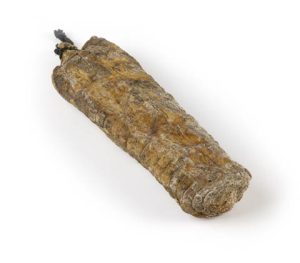
Loin 100% Duroc
Call it loin, head of loin or even tenderloin, the whole piece of lean pork, with well-infiltrated fat, seasoned with pepper and salt, stuffed, dried and matured. In its multiple forms and names, it is one of the greatest delights of Catalan gastronomy. At Can Fanera they make this piece with Duroc pork loin, salt, pepper, sugar and curing salts, and stuff it in a large pork casing. Some people like it sliced thinly, others thicker; it’s great for breakfast, as an appetizer or as a snack.
Company: Can Fanera
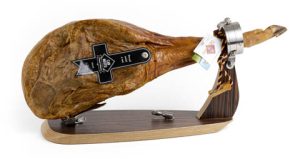
Can Mateu ham
Can Mateu ham is made with selected legs of the Duroc pig breed with a source weight of between 12 and 14 kilos. They are cured for a minimum of 24 months in cold storage until reduced to 35% of their initial weight. This meat company from Olot is recreating the artisan ham that used to be made in the farmhouses of the Garrotxa region, but now applying today’s technical and sanitary guarantees. The result is a very aromatic product with a strong umami taste.
Company: Pernils Can Mateu
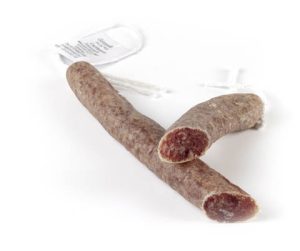
Fuet dolç (sweet fuet)
Joan Gironell is the third generation in a family butcher’s shop that opened in 1944 in Girona’s old quarter and produces the sweet fuet that has been rated the best by experts for the third consecutive edition of Girona Excel·lent. This fuet, made with a mixture of pork shoulder, sugar, salt, grated lemon rind and cinnamon, then left to dry, can be found at their stall at the Lleó Market in Girona. With a white crust from the sugar and its pink and shiny flesh, the fuet dolç is the most genuine charcuterie product from butchers in Girona province.
Company: Carnisseria Gironell
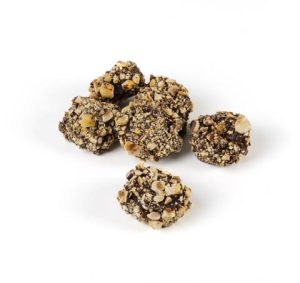
Sweet Fuet bombs with chocolate and hazelnut coating
Inspired by carnellets – small cakes made with sweet sausage meat to accompany All Saints’ Day festivities – which were introduced years ago by the Artisan Butchers and Butchers Guild of the Girona region, Embotits Boada Porcel gives us its delicious sweet fuet bombs, made with 75% Duroc pork, sugar and dark chocolate. Lluís Boada opened the butcher’s shop with his wife, Pilar Pons, in Vilobí d’Onyar, in 1976, and in 1987 he partnered with his sister Elvira and his brother-in-law Josep Porcel to found the company Embotits Boada Porcel. Later, they began raising pigs on their own farms.
Company: Embotits Boada Porcel