

One of the most heated debates in European societies is no longer about traditional cuisine, but home cooking and cooking at home. Cooking from scratch is laborious. At least in the Girona regions and in much of Catalonia, the first to notice that home cooking was in decline were the butchers. And before that, small cooked-legume shops sprang up around factories, especially textile ones, during the height of industrialisation, providing food for the men and women who worked there.
Butchers began producing festive dishes. Cannelloni found their way into professional kitchens and, although they are considered above all a festive dish, they are now made every day and feature on the menus of popular restaurants. And everything has gone one step further. There has been a culinary awakening, but now you do not need to start from scratch. Butcher shops, it must be said, encourage people to cook at home, by simplifying the steps, just as they would themselves at home. And now, in this catalogue, we will find ready-made dishes and preparations for preparing dishes quickly.
As we broaden our horizons, the range of ready-to-eat dishes is endless. It can be a sweet or savoury preserve, cold cuts or a cheese, but we understand each other when we talk about ready-meals, which only need a little heating, or preparations to speed up cooking, such as stocks or stir-fry bases. We find bases and sauces such as sofritos and samfaines, broths and fumets, which are preserved in jars and sterilised in a bain-marie or frozen. The range on offer is expanding in the commercial sector, where highly innovative ready-to-eat ideas are being launched, some inspired by home cooking, others by great traditional dishes.
In Spain, foods have been classified into different categories. The first is fresh products and other unprocessed food products. The second is preserves sealed in an airtight, long-lasting glass container. The third is frozen foods. The fourth is ready-to-eat fruits and vegetables. Although the term fifth category is often used as a broad umbrella for prepared meals, technically it refers only to precooked dishes that simply need reheating — in a microwave, a bain-marie, the oven, or a pan. There is also a sixth category of dehydrated, freeze-dried or ionised products, which have a very long shelf life at room temperature.
Butchers opted for the fourth and fifth categories, before it was known that these concepts existed; you only have to look at the counters displaying a wide range of prepared dishes, other than just cold cuts and cheese.
Ready-to-eat dishes with the 2025-2026 Girona Excel·lent seal

Palamós prawn carpaccio
The Palamós prawn must be the most popular of all the prawns caught in the eastern Mediterranean. Antoni Izquierdo, a specialist and lover of this most famous prawn, prepares them in a completely natural and artisanal way: very thin slices of freshly-caught prawn of the Aristeus antennatus species, considered the finest species of prawn from a gastronomic point of view. This carpaccio can be eaten as an appetizer or to top off a prawn rice dish made with his sofregit and Palamós prawn stock.
Company: Antoni Izquierdo Gourmet
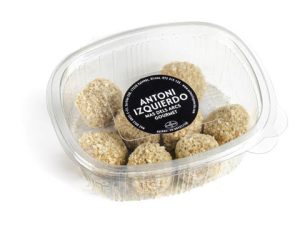
Palamós Prawn Croquettes
It must be said, Antoni Izquierdo has found the perfect way to extract the juice, flavour, and aromas from fresh prawns. Probably because he is from Palamós and has been living with them all his life, even when the prawns were unknown outside the port of Palamós. Toni, who was one of the founders and president of the pioneering chefs’ collective Cuina del Vent, makes an extremely tasty and elegant croquette.
Company: Antoni Izquierdo Gourmet
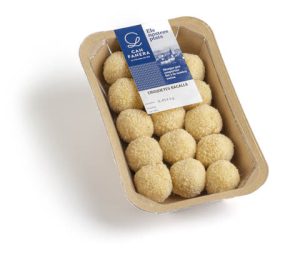
Cod Croquette
Can Fanera’s croquettes are made in the traditional way, with a béchamel sauce, made from butter, milk and flour, and cod emulsified with garlic-flavoured oil. At Can Fanera’s kitchen in La Cellera, they take the mixture and form the croquettes, and coat them with beaten egg and toasted bread soup. Now they are ready to be fried, and eaten as a main dish, as a starter or as a snack, as is increasingly common nowadays.
Company: Can Fanera
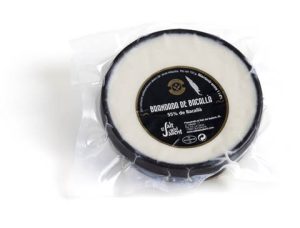
Cod brandade
Cod has been a staple in the kitchen since the time, from the seventeenth century or even earlier, it used to come as a salted or dried preserve, which meant that everybody could eat it since it could be transported anywhere. Thus, cod brandade, or cod emulsified with garlic and oil, is a traditional dish from classical cuisine, at least the contemporary version of this preparation. El Salt del Sallent makes their cod brandade with 55% cod, potato, oil and garlic, and it has a lovely texture. Precuinats El Salt del Sallent is an Olot-based company that specialises in food production, notably traditional products.
Company: Salt del Sallent
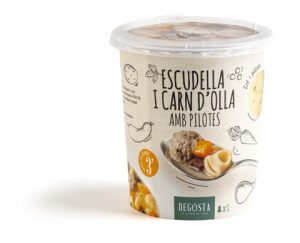
Escudella and Stewed Meat with Meatballs
In three minutes we can have an escudella soup and meat stew ready to eat in one go. This meal in an individual plastic bowl saves a good few hours of work and is inspired by the street food of other gastronomic cultures. Made with natural products and without preservatives, you just need to add water and heat it in the microwave. It has everything: black sausage, chickpeas, carrots, pasta and three types of meatball: chicken, cabbage and potato, and stewed meat.
Company: Cuinats Jotri
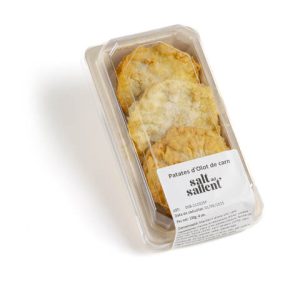
Olot potatoes
Olot or Bretcha potatoes are the most universal dish in the gastronomy of the capital of the county of Garrotxa. These stuffed potatoes were first created in La Deu restaurant in 1943, when the mayor of Olot and president of the Diputació de Girona, Pere Bretcha Galí, invited the civil governor and he asked for something different from the usual cannelloni or rice. An aunt from La Deu and a relative from Can Fermín de Besalú, on their honeymoon trip to Mallorca, had eaten some potatoes stuffed with meat which served as their inspiration for cooking very thin slices of potato stuffed with shredded roast meat, battered with beaten egg and fried in oil. El Salt del Sallent prepare the potatoes so they simply need to be baked, fried or grilled.
Company: Salt del Sallent
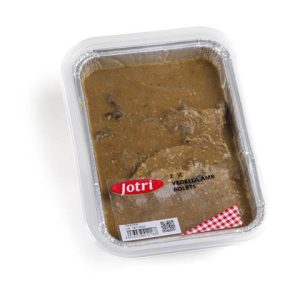
Beef with Mushrooms
Beef with mushrooms is one of the festive dishes of Catalan cuisine; depending on the cut of meat and how it is presented, we can call it fricandó, as is the case with this dish from Jotri, made with shoulder. When Josep Soler and Trini Salvà saw that cooked foods were the future and that there was a lot of demand for prepared dishes in butcher’s shops, they decided to quit being butchers in 2000. They also saw that there was as much demand for everyday food dishes as for festive cuisine, like this traditional beef with mushrooms, designed to be soaked up by a lot of bread.
Company: Cuinats Jotri
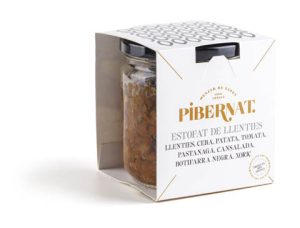
Lentil Stew
The Garrotxa company Pibernat Alimentària prepares this magnificent traditional dish, a nutritious and tasty casserole. For their lentil stew they use pardina lentils, onion, potato, tomato, carrot, bacon, black sausage and chorizo. One of the great things about this stew is the firmness of the lentils, which hold up without falling apart and entice you to dip bread in them.
Company: Pibernat
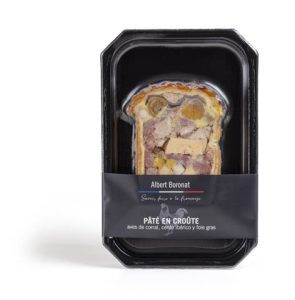
Albert Boronat Pâté en Croûte
Albert Boronat is a disciple of the great French chef Alain Ducasse, with whom he collaborated for a decade, during which he was responsible for one of his restaurants and contributed to several of his books, such as the Grand Livre de Cuisine Tour du Monde. He owns the takeaway food shop El Colmado, in Llívia, and the Albert Boronat – Savoir Faire à la Française brand. He has been a finalist in competitions such as the Championnat du Monde de Pâté-Croûte and winner of the Bocuse d’Or in Spain in 2019. In fact, his pâté en croûte, made with a 100% butter dough, high quality marinated meats with secret ingredients and dried fruit and nuts such as pistachios and figs, is one of the most celebrated. It is made in the CasaTOC kitchen.
Company: Casatoc al Mar
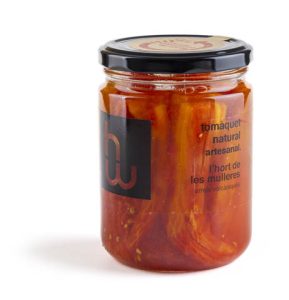
Natural Artisanal Tomato
One of summer’s rituals is preparing jars of tomato preserves. It’s a job that used to be done regularly when everyone had a garden – every day, several times a week – depending on the harvest, to prevent tomatoes that weren’t eaten from spoiling. Now they are bought and preserved on a specific day, like a ritual. Anyone who wants to save themselves this work, which requires many people, can opt for this natural, artisanal tomato from l’Hort d’en Mulleres. It is useful for making salads out of season, as well as for dipping bread or preparing sauces for rice or pasta.
Company: L’Hort de les Mulleres
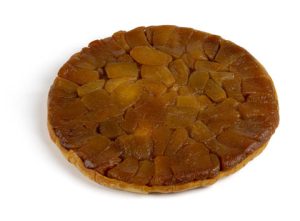
Mooma Apple Tatin
Apple Tatin is one of the most iconic and universal desserts in French gastronomy. The origin of the tarte Tatin is legendary and uncertain; the only certainty is that the name comes from the Hôtel Tatin, in Lamotte-Beuvron, in central France, run by sisters Caroline and Stéphanie Tatin. Mooma’s Apple Tatin is also very delicious, but with a fundamental difference compared to the one originally from the Loire Valley: it is made with apples from Girona.
Company: Mooma

Can Castelló Xuixo
The xuixo is a delicious elongated pastry, filled with artisanal cream, fried and sugared. Typical of Girona, it was invented in 1918 in the kitchen of a confectionery opened in 1912 at number 15 on Carrer de la Cort Reial in Girona. Castelló, which is now in the fourth generation of a family dedicated to baking and pastry since 1898, makes Girona xuixos as they should be, fried with cream inside. Under the El Xuixo de Can Castelló brand, it is the only company dedicated exclusively to making this typical Girona pastry.
Company: El Xuixo de Can Castelló