


Nuts have been an essential dessert since the Middle Ages, as revealed by some Christmas carols or books on royal events. They usually appear after dessert, to accompany coffees and liqueurs, or for dessert, when you don’t know what to order or don’t feel like having a full dessert. We call dried fruit for dessert grana de capella (priest’s grana) or postres de músic (musician’s dessert), depending on whether the household is clerical or liberal-minded. It’s worth noting that, in both cases, it was about having a few coins in your pocket to grab a bite whenever your strength gave out. The musicians, for their part, played all day long for local festivities: first at the solemn service, then at the sardanas in the square, and finally at the evening dance. And the priests, for their part, had to walk around the parishes where they had to say mass and they didn’t have much time to sit down.
They ate hazelnuts, walnuts, almonds, raisins, figs, pine nuts… all good sources of energy. In some peasant houses, they still have walnut, almond or hazelnut trees, and they go out into the forest to pick figs or gather pine nuts.
We also use nuts as an ingredient in many dishes — as a flavour enhancer and as a thickener in picades, a typical preparation in Catalan cuisine. The romesco sauce is another example, also based on a combination of nuts and other ingredients. There are as many picadas and romescos as there are families, lineages, towns and regions.
We also have a sweet cuisine based on dried fruit: nougat, panellets, tortells, cakes, biscuits and tortades. And we can make a meal with dried fruit and nuts in both the savoury and sweet dishes.
Dried fruit and nuts with the 2025-2026 Girona Excel·lent seal
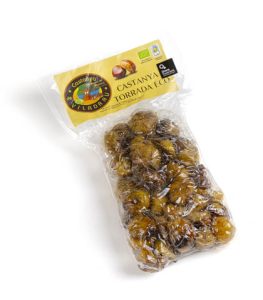
Organic roasted chestnuts
Castanya de Viladrau specialises in the recovery of 100-year-old chestnut trees in the Montseny Natural Park. They give guided tours and harvest the wood and nuts which are used to make various products. All the chestnuts are harvested by hand, roasted artisanally with chestnut wood and left to rest in chestnut wood crates. They are peeled by machine, although they are then checked by hand, and finally vacuum packed so they retain all their natural properties and appearance.
Company: Castanya de Viladrau
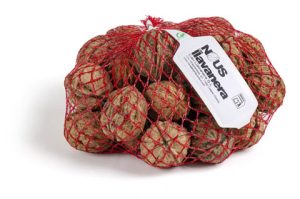
Can Llavanera walnuts
Can Llavanera is a family farm dedicated entirely to the cultivation of its 26 hectares of walnut trees, located around the banks of the Fluvià river, in the municipalities of Crespià, in the county of Pla de l’Estany, and Cabanelles, in the county of L’Alt Empordà. Can Llavanera is a farmhouse that dates back to the thirteenth century. Walnut cultivation was restored at the end of the last century with the plantation of the Hartley and Pedro varieties.
Company: Can Llavanera
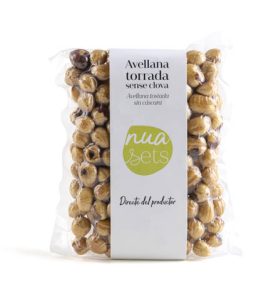
Nuasets – roasted hazelnuts
The absence of locally sourced hazelnuts in the shops led five producers from Brunyola, Sant Martí Sapresa and Estanyol to jointly start the Nuasets project, which takes advantage of the magnificent hazelnut plantations in that area of the counties of Selva and Gironès. Although fields of hazelnut trees have been documented for centuries in Selva, the variety known as Brunyola has prevailed. Nuasets cultivate a black hazelnut, the most highly-rated variety, because it is balanced and very tasty. Their precise point of roasting results in an aromatic, sweet and crunchy hazelnut.
Company: Nuasets
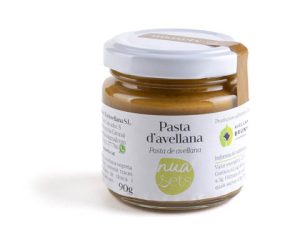
Nuasets – Pure hazelnut spread
The producers at Nuasets understand they need to offer a very wide range of products, based on the multiple possibilities of the hazelnut. One of the newest additions is this dark hazelnut spread from the Selva estate. First they are roasted to bring about Maillard reactions and then they are refined in the mill. Ideal for spreading and eating on toast, mixing with chocolate, making pralines or using in other sweet or savoury dishes.
Company: Nuasets